As you have seen in The Appraisal Group blogs on American Style, antiques come in all forms – from highly ornate to radial sawn oak to tubular steel and leather. A lot of folks these days are having issues with very ornate furniture. Like them or not, works of the period are magnificent in their own way and characterize America’s Gilded Age and its lifestyle.
The Belle Epoch – Gilded Age to us in America – was a time of conspicuous consumption. The industrial barons – Henry Morrison Flagler, J.P. Morgan, Andrew Carnegie, Andrew W. Mellon, and John D. Rockefeller and others – were to a maturing nation what Steve Jobs, Bill Gates, Donald Trump and others are to our times.

In the mid to late 19th century, newly minted millionaires gushed new money. They traveled to “the Continent” and brought back paintings, gilded furniture, even entire rooms from old castles to decorate their mansions and summer homes.
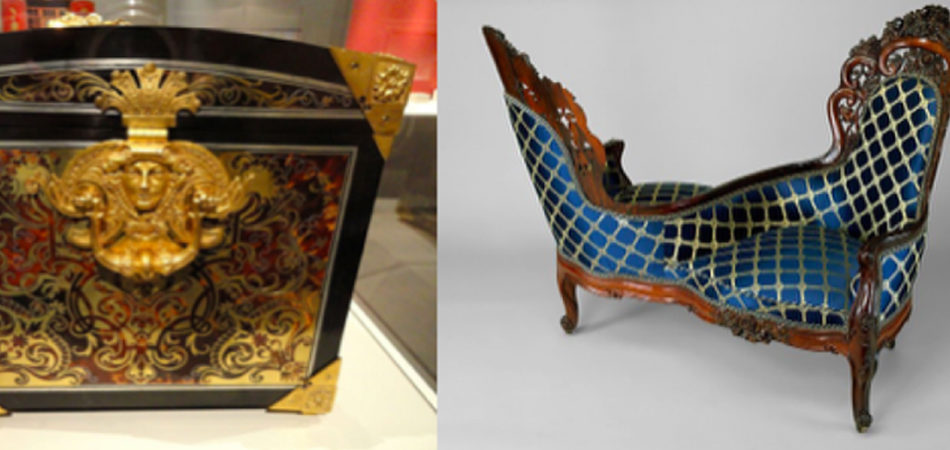
In the Gilded Age, the best the Americans could make of the French Revolution was to praise its elaborate furniture. The industrial barons delighted in works by André Charles Boulle (1642-1732), who decorated surfaces with brass, tortoiseshell, gilt copper, pewter, ebony. They fell for marquetry and parquetry, surface decorations of veneer inlaid to create geometric and decorative patterns.
Among the then-contemporary makers, they favored works by François Linke (1855-1946) who made extravagant furniture that fused Louis XV style rococo with the lively flowing lines of art nouveau.
American cabinet makers working at the time were equally as intricate as can be seen in works by Herter Brothers, a New York family who made furniture for Ulysses S. Grant’s White House and the Vanderbilts, among others. (Several pieces of Herter Brothers furniture remain in the White House including a center table and a slipper chair.)

John H. Belter, a German born cabinetmaker working in New York, is considered among the most original of the period’s furniture makers. He patented a method of steaming several layers of wood together that resulted in furniture that was thin, strong, and curved in two planes, a process that lent itself to amazing carvings. The effect gave us the rebirth of Rococo.
At The Appraisal Group we see a lot of Gilded Age antiques. As the taste filtered down to an emerging middle class of workers who couldn’t afford the best but could imitate, it became commonplace, creating a huge gap craftsmanship, quality and value. If you think you have Gilded Age antiques and fine art, it’s best to find out their worth.
Editor’s Note: Today’s featured image shows an oak casket (box) made and decorated by Boulle. The surface decoration includes brass, tortoiseshell,gilt copper, pewter and ebony. It is in the Chicago Art Institute. In the middle, is a Belter tete a tete, now in the Metropolitan Museum. Finally, a Herter Brothers cabinet.




 By Admin
  0 Comment
  Dec 16, 2022